



The Mental Game of Golf: A Practical Guide
The Mental Game of Golf: A Practical Guide

The Mental Game of Golf: A Practical Guide to Staying Sharp
“Golf is a game played on a five-and-a-half-inch course — the space between your ears,” as Bobby Jones put it, and most golfers who’ve played more than a handful of rounds already know he’s right. You can own a technically sound swing and still shoot ten strokes worse than you should because of decisions made between shots, not during them. The mental game of golf isn’t a vague, feel-good idea — it’s a specific, learnable set of habits, and it’s worth treating with the same seriousness golfers give their swing mechanics.
We’ve built Golf Gummies around this exact territory since 2020: the first-tee nerves before you’ve settled in, the pressure of a shot that matters, the focus that drifts over a long round, and the balance between having enough energy to finish strong and staying calm enough to putt well. This guide breaks down what the mental game of golf actually involves and what tends to help.
Why Golf Is Uniquely Mental
Golf gives you an unusual amount of time to think. A round runs four-plus hours, but the actual physical action — the swing itself — adds up to maybe 20 total minutes. Everything else is walking, waiting, and thinking, which means your mind has enormous room to either stay useful or work against you.
A few things make golf’s mental demands different from most sports:
- No continuous action — you get long stretches to dwell on the last shot or worry about the next one, unlike sports with constant motion that don’t leave room to think.
- Self-inflicted pressure — the ball isn’t moving, no one is guarding you, and the shot only gets harder the longer you stand over it thinking about it.
- A scorecard that remembers everything — one bad hole doesn’t disappear; it sits on the card, which can spiral into the next hole if you let it.
The Four Moments Where the Mental Game Shows Up Most
Across a typical round, most golfers notice the same recurring mental challenges:
- The first tee — nerves before you’ve hit a shot to settle into a rhythm
- A shot or putt that matters — the stillness before a consequential shot, when your pulse and your swing need to cooperate
- The stretch where focus drifts — usually mid-round, when fatigue and repetition make it easy to check out mentally between shots
- Recovering from a bad hole — the mental discipline to leave a bogey or worse behind instead of carrying it forward
Golfers who play consistently well tend to have built specific habits for each of these four moments, rather than relying on general willpower to power through all of them at once.
What Sports Psychology Says Actually Helps
The research and coaching consensus around golf’s mental game keeps landing on a few repeatable themes, not secret tricks. As one golf association put it plainly, golf really is as much a mental game as a physical one — and the practical habits that support it are learnable, not innate. A few worth building into your own game:
- Process over outcome. Committing to a target and a swing thought, rather than the result, reduces the second-guessing that tightens up a swing.
- A consistent pre-shot routine. The same sequence before every shot — a breath, a look at the target, a trigger to start — gives your mind a job instead of room to spiral.
- A short memory for bad shots. Golfers who recover quickest from a bad hole tend to have a specific, deliberate way of “closing the door” on it — a breath, a phrase, a walk to the next tee without replaying the shot.
- Managing energy, not just attention. Mental sharpness fades along with physical energy over a long round; staying mentally present on hole 15 is partly a focus problem and partly a fuel problem.
Building Your Own Mental Game Routine
You don’t need a sports psychologist to start improving the mental side of your game (though it doesn’t hurt if you want to go deeper). A simple starting framework:
- Before the round: a consistent warm-up and a few minutes to set an intention for how you want to respond to a bad hole, decided in advance rather than in the moment
- Before each shot: the same short routine every time, regardless of how much the shot matters
- After a bad shot: a specific physical or verbal cue that signals “that’s done” before you move to the next one
- Mid-round: a plan for energy — food, water, and steady focus support — so the back nine isn’t fighting fatigue on top of everything else
For more on building a strong start to your mental game before you ever reach the first tee, see our guide on boosting your brain before tee time.
Where Golf Gummies Fits
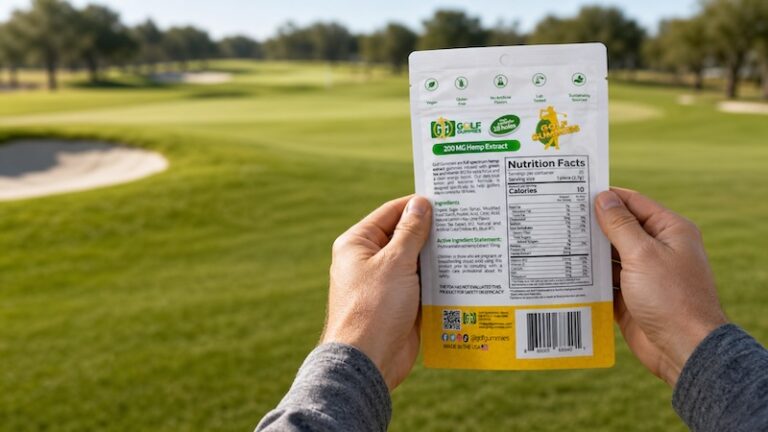
The mental game of golf is built through habits — a routine, a short memory, a plan for energy. Golf Gummies aren’t a replacement for any of that, but they’re built to support the physical side of staying mentally sharp: steady energy through Vitamin B12 and green tea extract, and calm through full spectrum hemp extract, so the mental habits you build have something to work with instead of fighting fatigue and jitters at the same time.
FAQ
What’s the single biggest mental game mistake golfers make?
Replaying a bad shot instead of closing the door on it. One bad hole doesn’t have to become two or three — golfers who recover fastest have a specific, practiced way of moving on.
Do I need a sports psychologist to improve my mental game?
Not necessarily. A consistent pre-shot routine and a plan for handling bad shots covers most of what recreational golfers need. A coach can help refine it further, but the basics are learnable on your own.
How is the mental game different on the back nine versus the front?
Physical and mental fatigue compound by the back nine, which is why focus tends to drift more there. Managing energy — food, hydration, pacing — is as much a mental-game tool as any routine.
Can a supplement actually help with the mental game of golf?
Not on its own — habits and routine do the heavy lifting. But steady energy and calm, rather than jitters or a crash, give those habits a better foundation to work from.
Try It for Yourself
The mental game of golf is built one round at a time, through habits that hold up under pressure — and having steady energy and calm to work with makes those habits easier to stick to. Try Golf Gummies →
Responses (0)
More from Golf Gummies

Best Supplements for a 36-Hole Golf Day
A 36-hole day is a different animal than your standard weekend round. You’re not just…

How Much Do Golf Gummies Cost? A Price Breakdown
Golf Gummies run $39.95 for a 20-count bag, or $9.99 for a 5-count sample pack…

Types of Golf Chewable Supplements, Compared
Golf chewable supplements aren’t one category — “chewable” just describes the format, and the actual…
Do Golf Gummies Really Work? An Honest Look
Reasonable question, and the honest answer is: it depends what “work” means. If you’re expecting…

No responses yet. Be the first to share your thoughts!