

Golf Fitness and On-Course Nutrition: Why the Two Go Together
Golf Fitness and On-Course Nutrition: Why the Two Go Together


Golf fitness has come a long way from “walk more, stretch occasionally.” Mobility work, rotational strength, and golf-specific conditioning are now standard advice for anyone serious about their game. But most golf fitness programs stop at the gym door. They build the engine — better hip turn, more clubhead speed, a swing that holds up on hole 16 instead of falling apart — without much thought for what actually fuels that engine once you’re four hours into a round, standing over a shot that matters, trying to keep your hands steady and your head clear.
That’s the gap we built Golf Gummies to fill back in 2020. Golf puts unusual demands on a body and mind at the same time: first-tee nerves that show up before you’ve even swung, the pressure of a putt or approach shot that decides the hole, focus that quietly drifts somewhere around the back nine, and the constant balancing act of having enough energy to finish strong without getting jittery or overcooked along the way. Fitness training addresses the physical side of that equation. On-course nutrition addresses the rest. Neither one does the whole job alone.
Golf Is More Physical Than It Gets Credit For
It’s easy to underestimate golf as exercise, but the numbers say otherwise. A round covers meaningful ground — often several miles when you’re walking — and stretches across four to eight hours depending on pace of play and course length, which puts real, sustained demand on the body over a long stretch of time, not a quick burst. Research measuring the physical demands of tournament golf has found that a round represents moderate, sustained physical activity, with energy expenditure that adds up over the course of a full 18 holes, not unlike other endurance-leaning activities. That’s exactly the kind of workload where conditioning and fueling both start to matter — you can’t out-stretch a nutrition gap any more than you can out-supplement a body that hasn’t been prepared for four hours of rotational movement and walking.
The Nutrition Side Most Golf Fitness Advice Skips
Search “golf fitness” and you’ll find plenty on hip mobility drills, core stability, and swing-specific strength work — all genuinely useful. What’s harder to find is guidance on what to actually eat or drink during the round itself, once the warm-up is over and you’re several holes in. A recent narrative review on nutrition and elite golf performance noted that nutrition has real potential to affect energy levels, focus, and consistency across a round, but pointed out that golf-specific nutrition research is still fairly limited compared to other sports — most of what golfers rely on is borrowed from endurance and precision-sport nutrition more broadly. In practice, that means the burden falls on individual golfers to figure out their own on-course routine, often through trial and error.
What On-Course Nutrition Looks Like Alongside Golf Fitness
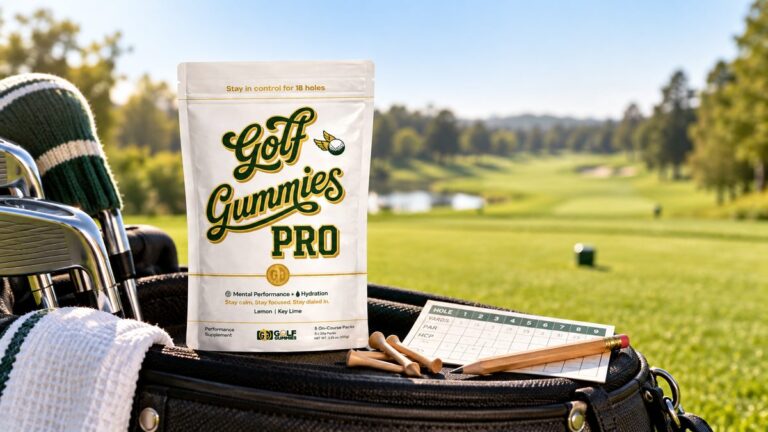
“Nutrition” during a round doesn’t mean a full meal between shots. It means paying attention to a few specific things that tend to fade as the round wears on: steady energy so you’re not flat by 15, hydration and electrolytes so cramping and fatigue don’t creep in on a hot afternoon, and enough mental steadiness to stay present on a shot instead of replaying the last one. That’s the thinking behind the ingredient stack in Golf Gummies Pro — cordyceps, time-release caffeine, and B12 for steady energy that doesn’t spike and crash; lion’s mane and Alpha-GPC for focus; L-theanine and L-tyrosine for a sense of calm under pressure; and sodium, potassium, and magnesium for hydration and stamina through the back nine. It’s built around one gummy before you tee off and another roughly every three holes, so support is spread across the round instead of front-loaded into a single dose that has to somehow last four hours.
Building Fitness and Nutrition Into the Same Routine
The golfers who get the most out of fitness training tend to treat nutrition as part of the same system, not a separate afterthought. If you’ve already got a warm-up routine — stretching, a few practice swings, maybe a walk around the range — that’s the natural moment to fold in your on-course nutrition plan too, rather than scrambling for something in your bag on the first tee. Our energy-boosting morning routine guide walks through a simple pre-round sequence that pairs well with any fitness warm-up you’re already doing.
Where Supplements Fit Into a Golf Fitness Routine
Supplements aren’t a replacement for conditioning work, and they’re not a substitute for the basics — sleep, hydration, and a reasonable warm-up still matter more than any single product. But as one piece of a broader routine, a supplement built specifically around the shape of a round can cover the gap that fitness training alone doesn’t reach: the mental and physical fade that shows up hours into play, after the warm-up has worn off. If you’re building out a fuller game-day stack, our guide to the top supplements for golfers breaks down where Golf Gummies Pro fits alongside the rest of a sensible routine.
As with any supplement, individual results vary. These statements have not been evaluated by the FDA, and Golf Gummies Pro is not intended to diagnose, treat, cure, or prevent any disease. Always check your sport’s specific rules and your organization’s compliance guidance before use.
FAQ
Does golf fitness training actually improve performance?
Golf-specific conditioning — mobility, rotational strength, and stability work — is widely recommended by fitness professionals and is built around matching the movement patterns actually used in a golf swing, though individual results depend on the program and the golfer.
What’s the difference between golf fitness and on-course nutrition?
Golf fitness generally refers to the physical training and conditioning that builds swing mechanics and durability over time. On-course nutrition refers to what you eat, drink, or take during the round itself to support energy, focus, and calm as the round progresses.
Do I need to eat during a round of golf?
Most golfers benefit from some form of steady fueling across a long round, given how much ground a round covers and how many hours it takes, rather than relying on a single meal beforehand to carry the whole day.
Can a supplement replace a golf fitness routine?
No. A supplement like Golf Gummies Pro is designed to support energy, focus, and calm during a round — it isn’t a substitute for conditioning, mobility work, or the physical training that builds a more durable swing.
When should I start incorporating nutrition into my golf routine?
Many golfers find it easiest to build nutrition into the same pre-round warm-up they already use for fitness — starting with the first tee and carrying a plan through the full round rather than treating it as an afterthought.
Bottom Line
Golf fitness builds the swing. On-course nutrition helps that swing hold up when it counts — hour three, back nine, the putt that decides the hole. Treat them as two halves of the same routine, and neither has to do the whole job alone.
Responses (0)
More from Thomas Cameron

Golf Fitness for Senior Golfers: Staying Loose, Focused, and Energized All Round
Golf doesn’t get easier with age — it just asks different things of you. A…

Golf Mobility Exercises to Add to Your Warm-Up Routine
Most golfers can name their swing flaw — coming over the top, losing posture, an…

Best Pre-Round Golf Stretches to Loosen Up and Get Focused Before You Tee Off
Most golfers show up to the course, pull the driver out on the range, and…
When to Take a Golf Performance Supplement Before You Tee Off
Most golfers treat a performance supplement like a cup of coffee: grab it on the…

No responses yet. Be the first to share your thoughts!