



Golf Nerves: Why They Happen & How to Settle Down
Golf Nerves: Why They Happen & How to Settle Down

Golf Nerves: Why They Happen and How to Settle Down Before You Swing
Every golfer knows the feeling: a tight chest on the first tee, a grip that’s suddenly too firm, a swing thought that won’t quiet down long enough to let you actually swing. Golf nerves aren’t a sign you’re bad under pressure — they’re a completely normal response to a sport that asks you to perform in short, isolated bursts, in front of people, with real stakes attached to a stationary ball that isn’t going anywhere until you hit it. That stillness is exactly what makes golf different from almost every other sport, and exactly why nerves show up here in a way they don’t on a treadmill or a driving range.
We built Golf Gummies around this problem back in 2020, starting with the most universal version of it: first-tee nerves, before you’ve hit a single shot to settle in. This piece goes deeper — why golf nerves happen, where they tend to show up beyond the first tee, and what actually helps.
Why Golf Nerves Hit Harder Than Other Sports
In most sports, nervous energy has somewhere to go — you can run it off, hit through it, let momentum carry you past the moment you were worried about. Golf doesn’t offer that release. You stand still over the ball, fully aware that everyone around you is watching you not move, and then you’re asked to execute a precise, repeatable motion in a few seconds of controlled effort.
A few things make this worse:
- No clock and no defender — there’s nothing external forcing the moment forward, so your mind has all the time it wants to build the shot up before you hit it.
- Isolation — a bad shot in golf is entirely yours; there’s no teammate to share it with or momentum to blame.
- Long gaps between the moments that matter — you might walk for ten minutes between shots, which gives nerves plenty of room to build before the next one.
None of this means something is wrong with you. It means golf’s format is uniquely good at manufacturing pressure out of stillness.
Where Golf Nerves Actually Show Up
First-tee nerves get all the attention, but they’re not the only version of this. Golfers tend to feel the same tightness in a few recurring spots over a round:
- The first tee, before you’ve hit a shot to settle in and while people are watching you start
- Over a putt that matters, when the stillness before the stroke gives your pulse time to spike
- Standing over any shot with a real consequence — a tee shot over water, an approach to a tucked pin, a shot to save par
- Playing with strangers or in a group better than you, which adds a layer of self-consciousness on top of the shot itself
Recognizing which of these hits you hardest is useful — it’s much easier to build a routine around a specific, recurring moment than to try to solve “nerves” as one big vague problem.
What Actually Helps: Building a Pre-Shot Routine
The most consistent advice from sports psychology on this topic isn’t about eliminating nerves — it’s about giving yourself something reliable to do with them. A pre-shot routine (the same sequence of steps before every shot: a practice swing, a breath, a look at the target, a trigger to start) gives your mind a job to do instead of spiraling around the outcome. One well-documented example: Lucas Glover’s pre-shot routine is often cited as a case study in how a consistent routine helps a golfer stay present under real tournament pressure, rather than getting pulled into the significance of the moment.
A few pieces worth building into your own routine:
- A physical trigger — a waggle, a practice swing, a specific grip adjustment — something repeatable that signals “now” to your body
- One breath, on purpose — a slow exhale before you start your routine does more than people expect to bring your heart rate down before a shot
- A target, not an outcome — focus on where you’re aiming, not on what happens if you miss
- The same routine every time — on a tap-in and on a shot to close out a match. Consistency is what makes it useful under pressure; a routine you only use when you’re nervous doesn’t have time to become automatic.
For a broader look at building calm, sharp habits into the start of your round, see our pre-round energy and focus routine.
Where Golf Gummies Fits
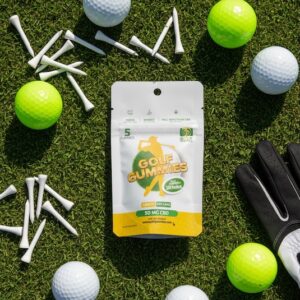
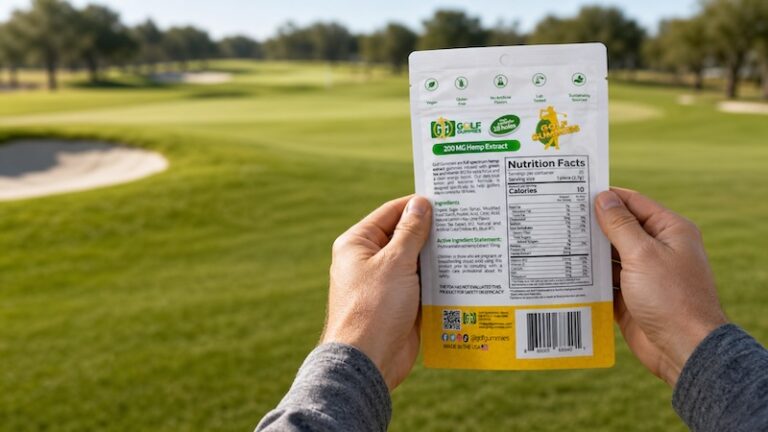
A pre-shot routine handles the moment right before you swing. Golf Gummies were built for the moments around it — the whole stretch of a round where nerves and drifting focus tend to show up. Each bag pairs 200mg of full spectrum hemp extract with 24mcg of Vitamin B12 and 30mg of green tea extract, aimed at the same balance a lot of golfers struggle to find on their own: enough energy to stay sharp for four-plus hours, without the jitters that make a tight moment feel tighter. We’re careful not to oversell this — it’s not a fix for nerves, and it doesn’t replace a routine. It’s a small, steady input alongside one.
FAQ
Are golf nerves normal, or does it mean I’m not cut out for pressure situations?
Completely normal. Golf’s format — long stillness followed by a short, isolated moment of performance — is specifically good at producing nerves, regardless of skill level. Tour pros deal with the same thing; a routine is how they manage it, not something that makes it disappear.
What’s the fastest way to calm down before a shot?
One slow, deliberate breath before you start your pre-shot routine is the simplest and most repeatable option. It won’t erase the moment, but it interrupts the spiral before it builds.
Do golf nerves get better with experience?
Often, yes — but usually because experienced golfers have built a routine they trust, not because the moment itself gets less significant. The routine is doing the work.
When should I take a Golf Gummies before a round if first-tee nerves are the issue?
Most golfers take one about 20–30 minutes before tee time, so it has time to settle in before you’re standing over that first shot.
Try It for Yourself
If the first tee (or the twelfth, or the eighteenth) tends to get to you, a steady pre-shot routine is the foundation — and having something built for the rest of the round doesn’t hurt either. Try Golf Gummies →
Responses (0)
More from Golf Gummies

Best Supplements for a 36-Hole Golf Day
A 36-hole day is a different animal than your standard weekend round. You’re not just…

How Much Do Golf Gummies Cost? A Price Breakdown
Golf Gummies run $39.95 for a 20-count bag, or $9.99 for a 5-count sample pack…

Types of Golf Chewable Supplements, Compared
Golf chewable supplements aren’t one category — “chewable” just describes the format, and the actual…
Do Golf Gummies Really Work? An Honest Look
Reasonable question, and the honest answer is: it depends what “work” means. If you’re expecting…

No responses yet. Be the first to share your thoughts!